
GUIDE
How Is Attar Made? Inside Deg and Bhapka Distillation
Mirage Attars · 10 August 2026
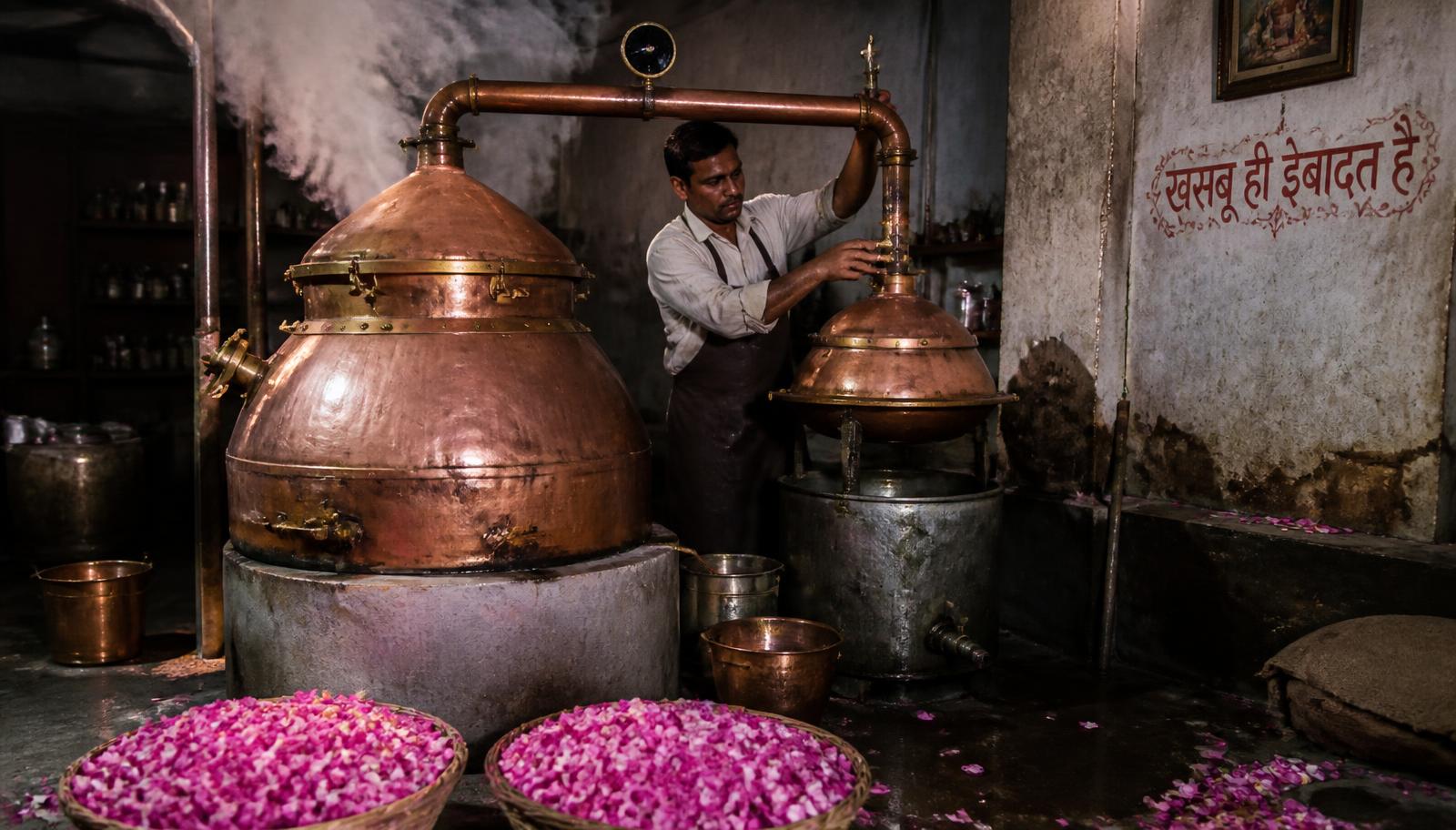
Copper vessels, no electricity, and a distillation that can take fifteen days. How traditional Indian attar is actually made — and how modern attars are blended.
The oldest working perfume method still in commercial use anywhere in the world is in Uttar Pradesh, and it runs on firewood. No electricity, no pumps, no thermometers. A perfumer in Kannauj judges an entire distillation by putting a hand on a copper vessel and listening to it.
This is how attar is made.
The deg and bhapka method
The apparatus has two halves.
- The deg — a large copper still, filled with flowers and water and sealed with clay and cotton.
- The bhapka — a rounded copper receiver, sitting in a trough of cool water, holding the base oil that will catch the fragrance.
A bamboo pipe joins the two. Fire is lit under the deg with wood or cow-dung cakes. Steam carrying the flower's aromatic compounds travels down the pipe and condenses directly into the oil waiting in the bhapka. There is no separate collection of essential oil and no blending step — the scent goes straight into its carrier.
Why it takes so long
The receiver has to be emptied of accumulated water, cooled and returned again and again. A single batch is charged, distilled, decanted and recharged for anywhere between seven and fifteen days, sometimes longer for the finest roses. The perfumer, the dehnwala, controls the fire by feel. Too hot and the delicate top notes cook off. Too cool and the oil never saturates.
At the end, the oil is left to settle so residual water separates, then rested in leather bottles called kuppi, which allow the last moisture to escape while the scent stays in.
What the flowers cost
The arithmetic is brutal, and it explains the price of real attar.
- Roughly 3,000 to 4,000 kilograms of rose petals for one kilogram of rose oil.
- Jasmine picked before sunrise, because the flower stops producing scent once the sun is on it.
- Kewda, saffron, mitti — the last being baked clay discs distilled to capture the smell of the first rain on dry earth.
Oud is a different story entirely
Oud is not distilled from a flower. It is resin formed inside an agarwood tree only after the tree is infected by a specific mould, a defensive reaction that can take decades. Infected heartwood is chipped, soaked, and slowly distilled. The yield is tiny and the variation enormous, which is why genuine oud is among the most expensive raw materials on earth and why so much of what is sold as oud is a blend built around a small amount of it.
Ageing
An attar is not finished when it leaves the still. Fresh oil is sharp and unsettled. Months in a sealed vessel let the components bind, the harsh edges round off and the base deepen. Serious houses age their oils for a year or more. This is the step that is skipped most often, and it is the difference you smell at hour four.
How modern attars are made
Most attars sold in India today are not single-flower distillations, and honesty about that matters.
A modern attar is a composition — natural distilled oils, absolutes obtained by solvent extraction, and high-quality aroma molecules blended to a formula, then matured. This is how a leather, a marine accord or a modern amber becomes possible at all, since none of those exist as a flower you can put in a deg. Done well, blending is a craft, not a shortcut: the perfumer is balancing top, heart and base so the scent still moves over hours.
Done badly, it is oil plus solvent, loud for one hour and gone.
How Mirage Attars works
We are a Delhi house, not a distillery. We source oils — Indian distillations and imported compositions — and build our two editions around them.
- Basic Edition, Rs 349 for 6ml. Everyday oils, four to six hours of wear.
- Classic Edition, Rs 549 for 6ml. Imported oils with heavier bases, twelve hours and more on the oud, leather and vanilla profiles, six to eight hours on fresher notes.
Everything is alcohol-free, hand-decanted into 6ml and 12ml roll-ons in Okhla, and rested before it is sold rather than bottled the day it arrives.
The point of knowing this
You do not need to know distillation to enjoy a fragrance. But it does tell you what to expect from a price. An attar that costs less than a plate of biryani is not a fifteen-day rose distillation, and anyone claiming otherwise is selling you a story. What a good affordable attar can be is a well-balanced, properly aged composition that lasts a full day — and that is exactly what we set out to make.
QUESTIONS
- How is attar made?
- Traditional attar is made by the deg and bhapka method. Flowers and water are sealed in a copper still over a wood fire, and the fragrant steam condenses directly into a base oil held in a copper receiver cooled by water, over seven to fifteen days.
- What is the deg and bhapka method?
- The deg is the copper still holding flowers and water; the bhapka is the receiver holding the base oil. A bamboo pipe joins them, and the perfumer controls the fire by feel, recharging the still repeatedly until the oil is saturated.
- How many roses are needed for one kilogram of attar?
- Roughly 3,000 to 4,000 kilograms of rose petals are needed to produce one kilogram of rose oil, which is why genuine floral attars are expensive.
- Why is oud attar so expensive?
- Oud is resin that forms inside an agarwood tree only after a specific mould infection, a process that can take decades. The yield is very small and the distillation slow, so genuine oud is among the costliest perfumery materials in the world.
Wear the house.
SHOP THE ATTARS